Showing posts with label fashion. Show all posts

Tuesday, August 05, 2008

PLA T-shirt

Here is this year's design.

On the back:


I've never cared to hide my nerdiness. I'm perfectly happy being the one symbol in the list that isn't part of a natural class. (If you know what that means you're probably one of those symbols too.)

So now I get to proudly wear a shirt proclaiming my tripartite nerdiness: linguist, environmentalist, pollyanna.

Well done Sunny.

Monday, November 26, 2007

Distinctive features

Am I allowed to say that some language choices annoy me? How about if I promise not to call them pet peeves?

A while ago Mxrk posted about Paul Brians' list of non-errors that are commonly called errors. It's a decent list full of forms that occur regularly and which function within many constraints of standard English grammar.

But I take partial issue with one point Brians makes. Regarding the ongoing argument that attributive woman is incorrect and female should be used because it is an adjective while woman is a noun Brians explains

It may be inconsistent, but the pattern of referring to females as women performers, professionals, etc. is very traditional, dating back at least to the 14th century. People who do this cannot be accused of committing an error.


It's true this is not a grammatical error. So I'll go along with it that far.

But there is still something jarring about the form. I'm trusting my naked ear when I expect 'female doctor' or 'female pilot' or 'female police officer' to follow an already established relevance of the sex of the person. So I would expect 'female-X' to be used in contrast to and with the co-occurrence of 'male-X' -- not just plain ol' 'X'.

But I would expect 'woman-X' to occur as a privative feature: there are doctors and some of them are woman doctors; We've had presidents and we might one day have a woman president.

The issue here is what I see as the unnecessary qualifier. Consider the label given to models that weigh more than 90 lbs. 'Plus-size models'. Is this necessary? Well I expect that in a few years it'll change. Eventually full-figured will lose the ridiculous connotation of surplus and it'll make sense for a model with a complete body as opposed to those half-figured models out there.

And then will this →
be called a plus-ugly model? Or would that be minus-pretty?

And let me just call attention to my own bias in a discussion of models that focuses on female models only. There are plenty of man-models out there that make me feel insecure with my own plus-size/minus-handsome-ness.

Sunday, August 26, 2007

Minimal pairs of another sort

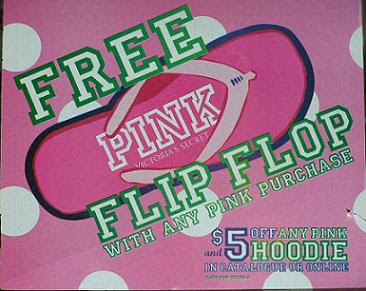
This post might be a silly excuse to post a picture from a Victoria's Secret promotion.

For some reason the fashion industry likes to turn plurals into singulars. Many a runway show announcer has called attention to "a pleated pant."

Over on this JCPenney page the heading uses singular "pant" tho the individually men's Dockers® are listed as "pants" while the women's Cabin Creek® item is listed as a "pant". But I can't find a pattern because on this page, five of the women's Dockers® take the plural and one (the Sydney pant) takes the singular.

This CBS Sports Store page uses the singular for every pair of pants on the page.

In Spanish it's possible to use both the singular and plural as well. Either pantalón or pantalónes. Buffy tells me there's a lyric out there "llevaba camisa oscura y pantalón claro" in a song titled "Desapariciones" by Maná. And of course there is an episode of the French television series Le Mythomane (The Pathological Liar) titled "Un pantalon tout neuf" (A Very New Pant).

And for the stage directions of The Taming of the Shrew to call Gremio "a pair of pantaloons" would just be silly. The singular form predates the plural form as it is a shortened form of pantaloon a word that rose from San Pantaleone and settled into use as both a type of character in Italian comedies and the typical costume. The OED mentions "the Venetian character Pantaloon" dating from 1561 or sooner.

The etymology has nothing to do with the outfit. It goes back to a combination of Gr pantos (gen pan, universal, in combinative use all, or every); and leōn, lion.

It probably picked up the plural use because of the obvious bifurcate construction of the suit.

So is the fashion and garment industry preserving an original use or has it introduced a form that only happens to coincide with an earlier form? (This is one of my favorite issues in language use/change and one which will get a lot of attention in my dissertation).

Well there is evidence that the fashion industry just likes to call things by the singular. Buffy has received in the mail about 7 postcards from her favourite outfitter: Victoria's Secret. The offer sounds like a lame giveaway of only one little sandal. But she went anyway to claim her gift and sure enough--they gave her one for each foot.

Pink Flip Flop

What kind of picture did you expect I would post?
--------

Thursday, July 26, 2007

Sock it to me

I'm notoriously loath to match my socks. Almost everyone that knows me knows this about me. And I love fancy socks. So my socks are always calling attention to their mismatched role. Before I was married everyone told me I needed a wife to match them for me. First of all that's sexist. Why should I expect my wife to do it if I wouldn't do it myself? Secondly it's just not worth the effort because I own so many socks and most of my favourite socks have lost their partner. So it saves me money too. If I lose one sock with ducks on it it doesn't matter because those go perfectly with my purple and green argyle sock.

Fade out...

...fade in

"Sagehen" posted several days ago on ADS-L a suggestion regarding some problematic axioms.

If "proof" is thought of as a process, a test, and not just as the completed demonstration, through testing, of the truth of something, odd-seeming expressions like..."the exception that proves the rule" become sensible. ..."the exception that tests the rule."


It might work. That phrase has puzzled me for a long time. Why would any exception prove that a rule is being applied? If the rule is that a train passes every hour on the hour why would the one hour when the train fails to go through prove the rule?

Or perhaps (and this feels like a stretch the rule is that the train passes by only on the hour and since the exception is every other part of the hour that's what creates the rule. Follow? The train flies by on the hour. So at 12:10 there's no train. At 12:23--no train. At 12:49...got the point? And at 1:00 there's a train and we now have our rule.

Well it's inelegant so I won't try to sell it.

Laurence Horn is familiar with the question and offers some insight on a follow-up post to the list. He provides an explanation by Michael Quinion who writes

It's not a false sense of 'proof' that causes the problem, but 'exception'. We think of it as meaning some case that doesn't follow the rule, whereas the original sense was of someone or something that is being granted permission not to follow a rule that otherwise applies. The true origin of the phrase lies in a medieval Latin legal principle: 'exceptio probat regulam in casibus non exceptis', which may be translated as 'the exception confirms the rule in the cases not excepted'.

Let us say that you drive down a street somewhere and find a notice which says 'Parking prohibited on Sundays'. You may reasonably infer from this that parking is allowed on the other six days of the week. A sign on a museum door which says 'Entry free today' leads logically to the implication that entry is not free on other days (unless it's a marketing ploy like the never-ending sales that some stores have, but let's not get sidetracked). H W Fowler gave an example from his wartime experience: 'Special leave is given for men to be out of barracks tonight until 11pm', which implies a rule that in other cases men must be in barracks before that time. So, in its strict sense, the principle is arguing that the existence of an allowed exception to a rule reaffirms the existence of the rule.


As I read it that's a more elegant explanation of my little train story. An easier sell.

How else might this phrase work?

Fade out...

...fade in

People have trouble believing me when I tell them that I don't purposefully mis-match my socks. I just don't match them once they're out of the wash and when I grab them from the drawer (or the basket that they're almost always still sitting in) I put on the first two that I pick up. It's completely random.

"Yeah but if it was a matching pair wouldn't you put one of them down?" they ask.

"No" I say. "If they match that's the exception that proves the rule."